// blog
Five Lease Terms That Change a Tenant's CAM Bill, With the Numbers
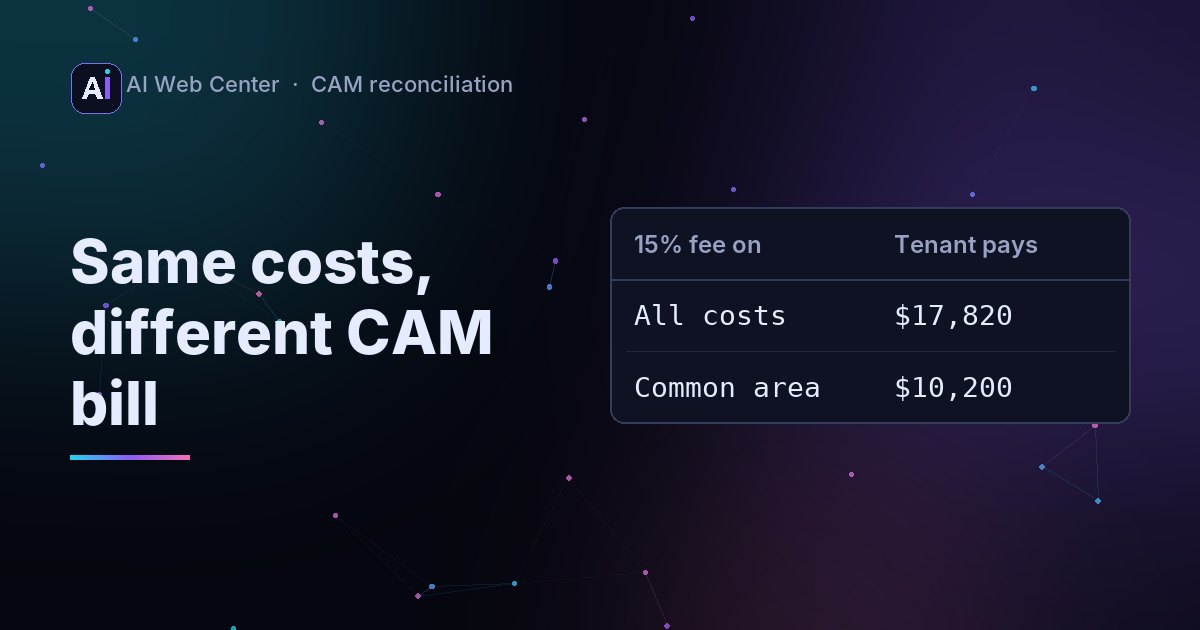
Five lease terms change a tenant’s CAM bill the most for the same costs. The admin fee’s base: a 15% fee costs a 4% tenant $17,820 on all expenses or $10,200 on common area costs alone. The denominator: a 5% tenant pays $17,000 over the whole center or $28,333 over occupied space only. Cumulative or non-cumulative caps: $4.63 or $4.37 a square foot in the same year. Cap order: Harbor Court’s tenant pays $316,266 with the cap before gross-up and $297,563 with it after. And gross-up itself. The figures come from published examples, and each one can be checked in our free CAM wizard.
Two tenants with the same square feet in the same center can get very different CAM bills, and the difference usually isn’t in the costs. It’s in a few lines of the lease. Here are five, each with a worked example someone else published. Every one is built into our CAM reconciliation wizard under Check it against published examples, with the wizard’s figure next to the source’s.
1. What the admin fee is charged on
Julian R. Sterling’s example is a 150,000 sf building with $2,970,000 of operating expenses and a 6,000 sf tenant, 4.0%. The fee is 15% every time; only its base changes:
| The 15% is charged on | Tenant’s fee |
|---|---|
| All operating expenses | $17,820 |
| All but taxes and insurance | $10,920 |
| Common area costs, without taxes, insurance and the management fee | $10,200 |
| Controllable costs only | $8,400 |
Same rate, more than twice the money. The lease’s definition of the fee’s base matters more than its percentage.
2. The denominator
In GrowthFactor’s example a 4,250 sf tenant is in an 85,000 sf center with a $340,000 CAM pool. Divided over the whole center, the tenant’s share is 5.0%, or $17,000. If the center is 60% leased and the lease divides by occupied space, the share becomes 8.3%, or $28,333: the tenant picks up part of the vacant space’s share. Many leases put a floor under an occupied-space denominator for exactly that reason.
3. Cumulative or non-cumulative caps
The same source has a 5% cap on a $4.00 a square foot base, and a year three in which actual CAM jumps to $4.74. A non-cumulative cap works from last year’s bill, $4.16, so the tenant pays $4.37. A cumulative cap compounds from the base and keeps the room left over from cheaper years, so the tenant pays $4.63. Over five years GrowthFactor puts the difference at about $0.74 a square foot.
4. Whether the cap comes before or after gross-up
In Agora Real’s Harbor Court, Tenant A’s lease applies a 5% cap to controllable costs before grossing them up to 95% occupancy. Done that way, the annual charge is $316,266. Apply the cap after the gross-up instead and it’s $297,563; drop the cap and it’s $322,500. Which order applies is the lease’s call.
5. Gross-up
When a building isn’t full, costs that rise and fall with occupancy, such as janitorial and utilities, are restated as if it were, usually at 95%. Yardi’s own guide gives the formula with a 100,000 sf building at 75%: expenses of $20,000 × 95/75 × the tenant’s 10,000/100,000 share. Gross-up only applies where the lease allows it, and only to costs that vary; plenty of leases say nothing about it, and silence doesn’t allow it.
Checking your own
None of this says which reading is right for a given lease; the wording does. What the examples show is how much rides on it. To see it with your own numbers, the wizard runs in your browser and uploads nothing. It’s a free demo, not accounting, legal or tax advice.
Frequently asked questions
Where do the numbers come from?
From the published worked examples linked in each section. We didn't change their figures; each example is also built into the CAM wizard, where the wizard's result sits next to the source's.
Which reading is right for my lease?
The lease language decides, and it varies. These examples show how much the wording matters, not which reading applies to you. This isn't legal or accounting advice.