One board viewer, on any website
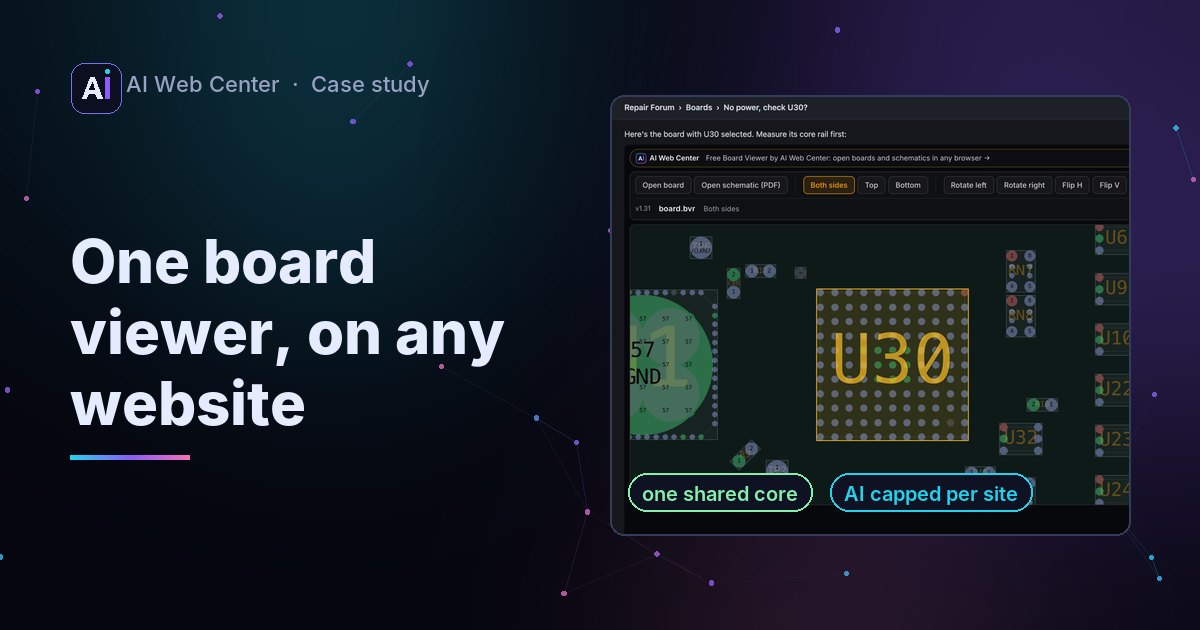
We made our free board viewer embeddable in other websites. A site adds a div and a script; its own page reads the board file and hands it to the viewer, so attachments behind a login work and nothing changes on its server. The embed is the same viewer as our own page, with options for colors, the toolbar and the part to show. Ask AI runs with limits per visitor, per site and per month, and a site can use its own AI through a relay that keeps its key on its server.
The problem
Our free board viewer opens boardview files and their schematics in a browser, with known-good readings and an AI assistant for repair work. Repair forums and board archives were the natural places for it, but a link to a board only works if the site holding the file sends a header that lets other sites read it. Most forums can’t add that, and their attachments sit behind a login anyway.
The goal: let any of those sites show the viewer on their own pages, with the board open, without changing their servers, without the files passing through ours, and without their visitors’ AI questions running up an open-ended bill.
What a site does
<div class="aiwc-board" data-board="/attachments/12345" data-part="U7400"></div>
<script src="https://aiwebcenter.com/embed/board-viewer.js" async></script>
| Result | How |
|---|---|
| No server changes for the site | Its own page reads the file and hands it to the viewer |
| Attachments behind a login open | The page reads them as the member who’s signed in |
| The file never reaches our server | It goes from the site to the visitor’s browser and is read there |
| Options to fit each site | Theme, color, a smaller toolbar, height, side, tab, a part or net selected, and the site’s own AI |
| Our name on every embed | A strip with rolling links to our site, in the site’s color, and a credit link |
| AI costs with a ceiling | Limits per visitor, per site and per month, and partners’ own AI |
The decisions
One core, two homes
The embedded viewer is the same React component as our own page, given an embed property. There’s no second copy to keep in step: a fix to a file reader, the schematic link or Ask AI reaches every embedding site the moment it’s deployed.
The host page does the reading
A frame from our site can’t read a forum’s files without that forum’s permission, and it can’t use the forum’s login. The forum’s own page can. So our small script on that page reads the file and passes the bytes into the viewer’s frame with postMessage, transferring them rather than copying. Both sides check who they’re talking to: the viewer listens only to the page directly around it, and the script answers only the frame it created, from our exact address.
Only one page may be framed
Every page on our site refuses to be shown in another site’s frame. That stays. Only the embed page allows it, set per path in nginx, and it has no sign-in and nothing to click on anyone’s behalf.
AI with a ceiling at every level
Repeat questions come from a library of checked answers and cost nothing. New questions have a limit per visitor per day, a cap per site per month, and a monthly budget for all board AI that alerts Jan’s phone when it’s reached. For now every embedding site gets Ask AI for free, up to its cap, until a set end date. In the admin, each site has a switch, a cap and a note of who pays, and sites we haven’t listed show up with their views and spend.
The site’s name comes from the visitor’s browser, so it can’t be proven. The per-site cap is what bounds a site that lies about who it is.
Their own AI, never their key
A site with its own AI account sets data-ai to a small relay on its own server, which adds its key and forwards the question to its AI. We still look the question up in our library first, hand back the exact instructions our AI would get without calling any AI, and check the answer for values that aren’t in the board’s data. Their key never leaves their server, and their questions never reach our bill. The guide shows the relay as a Cloudflare Worker, in Node.js, Python, C# and PHP, and says in bold never to put a key in the page.
Small things that would have broken it
- Blocked storage: some browsers block storage in a third-party frame. A few of the viewer’s settings writes weren’t guarded, and inside a frame they would have thrown. Every write now goes through one helper.
- Options from the address: read by one function that accepts only known values. A color is only
#rgbor#rrggbb, so nothing else reaches the page’s styles. - Code samples: the site’s code font joined
===and=>into single symbols. Fine to read, wrong to retype, so it’s off in code.
How it was checked
- Two local servers on different ports, one as a forum and one as our site, so the browser treats them as separate sites. Headless Chrome checked that the board opened from the forum’s own file without any header, that the options applied, that Ask AI stayed hidden where it was off, and that the strip rolled.
- A stand-in for a site’s own AI streamed an answer back through the viewer, and our check flagged a value the board data didn’t have.
- The relay examples compile, and the Node.js one was run against a stand-in AI.
- On the live site: only the embed page allows framing, the library check returns the instructions without calling any AI, and the value check works on its own.
What it means for your product
The same questions come up whenever a business lets partners or customers use its software on their own sites: how to share one codebase, how to pass data without opening holes, and how to keep AI costs bounded when you don’t control who asks. If that’s on your table, the first 30-minute call is free.
Try it: the viewer · the guide for websites · for forum owners · AI on other websites · embedding, safely